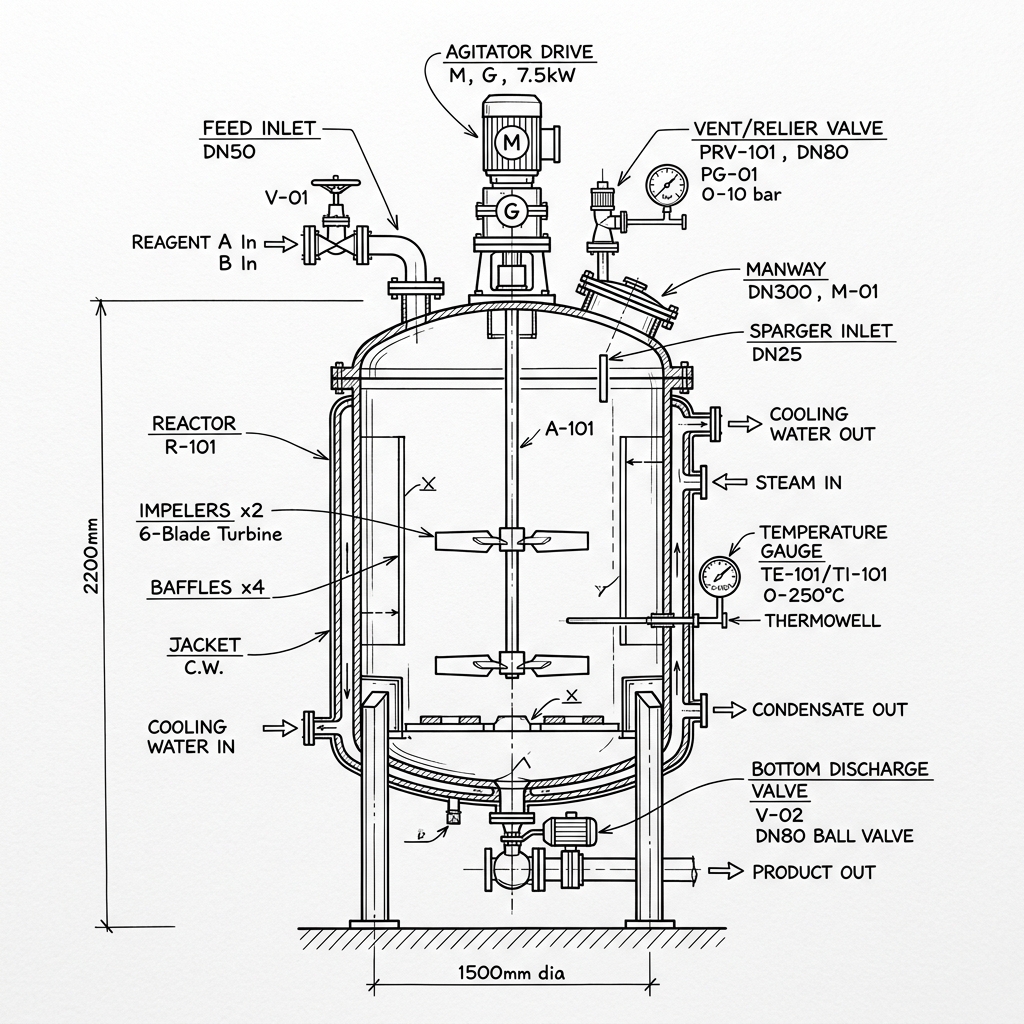
Emergency Relief System Design for Runaway Reactions in Pharma
Exothermic chemical runaways in batch reactors present a unique pressure relief challenge. Unlike standard vapor relief systems, runaways involve rapid kinetics that can trigger two-phase vapor-liquid flow. If standard single-phase equations are used to size the relief valve, the valve will be undersized, leading to reactor rupture.
To design safe emergency relief systems for reactive chemistry, engineers utilize the DIERS (Design Institute for Emergency Relief Systems) methodology.
1. The DIERS Methodology
DIERS replaces simple gas-flow equations with complex models that account for two-phase flashing flows. Sizing is governed by the reaction system type:
- Vapor (Tempered) Systems: The reaction solvent boils off, and the latent heat of vaporization absorbs the reaction heat, tempering the temperature. Sizing depends on solvent boil-off rates.
- Gassy Systems: The reaction generates non-condensable gases (e.g., nitrogen or carbon dioxide). The pressure rises independently of temperature, making containment challenging.
- Hybrid Systems: The reaction generates both condensable vapor and non-condensable gas.
2. Sizing Equations: The Fauske HEM Method
For two-phase flashing flows, the Fauske Homogeneous Equilibrium Model (HEM) is widely used. The critical mass flux (G) is calculated using:
G = ( h_fg / v_fg ) * square_root( 1 / ( T * Cp ) )
Where:
- G = Critical mass flux (kg/m²s)
- h_fg = Latent heat of vaporization (J/kg)
- v_fg = Change in specific volume between vapor and liquid phase (m³/kg)
- T = Relieving absolute temperature (K)
- Cp = Specific heat capacity of the liquid (J/kgK)
The required vent area (A) is then calculated by dividing the kinetic volumetric expansion rate by the critical mass flux.
3. Reference Standards Used
- CCPS Guidelines for Pressure Relief and Effluent Handling Systems: Incorporating the DIERS project manual.
- ASME Section VIII Appendix M: Rules for installing safety relieving devices.
- Leung two-phase venting calculations: Standard equations for reactive chemical relief.
🛠️ Interactive Engineering Tool
To perform calculations related to this topic, access our interactive engineering tool: Emergency Vent Sizing Calculator.