Safe, Scalable Process Engineering Solutions

Pharma Chemical
Engineering Hub

Process Engineering, Scale-Up, Technology Transfer, Process Safety, Utilities, and Pharmaceutical Manufacturing Excellence.

Comprehensive Process Engineering Platform

Empowering engineers with high-fidelity validation models, mechanical sizing tools, and rigorous technical guidelines.

Latest Technical Publications

Peer-reviewed detailed process guides, calculations methods, and safety controls.

Browse All Articles

Community Engineering Discussions

Join active technical threads, discuss scale-up dilemmas, and exchange cGMP solutions with fellow process engineers.

Only registered community members can start threads or answer.Log In orSign Up to participate.

Rajesh S.(Sun Pharma)
Sep 6

How do we prevent localized hot plumes and bis-adduct side impurities during rapid reagent addition in a 10 KL reactor?

Kiran S.(PharmaChemEng Hub)Sep 6

Hi Rajesh, This is a classic Damköhler mixing-controlled regime problem (Da_I = tau_mix / tau_rxn >> 1.0). When you add reagent from a top nozzle into a 10 KL vessel, bulk macromixing takes 45-90 seconds, whereas fast competitive reactions (like Grignard additions, acylations, and chlorinations) react within milliseconds. Incoming reagent droplets form a localized "hot plume" of unmixed reagent that attacks already-formed mono-product (A + B -> C, then C + B -> D), generating high levels of over-alkylated/bis-adduct impurities. Key Engineering Solutions: 1. Install a Subsurface Dip-Pipe: Direct the feed stream directly into the high-shear impeller discharge stream (discharge tip of the lower pitched blade turbine). This cuts micromixing engulfment time (tau_E) by >85%. 2. In-Line Static Mixer: Loop a small side-stream through an external jacketed static mixer where reagent is dosed under turbulent inline shear before returning to the vessel. 3. Cascade Temperature Control: Slave the jacket cooling valve to the reactor bulk temperature derivative (dT/dt) to preemptively trim cooling before the batch overshoots.

Priya N.(Dr. Reddy's Laboratories)Sep 7

We experienced this exact issue during technology transfer from 50 L pilot to 8 KL plant. Subsurface addition at the impeller discharge lowered our bis-impurity from 2.8% down to 0.18% without extending batch cycle time!
Priya N.(Dr. Reddy's Laboratories)
Sep 4

Why is our ANFD filtration cycle taking 16 hours at 5 KL scale while the lab Buchner funnel filtered in under 3 minutes?

Kiran S.(PharmaChemEng Hub)Sep 4

Hi Priya, Filtration scale-up is governed by Specific Cake Resistance (alpha_cake), which depends on Crystal Size Distribution (CSD): dt/dV = (mu * alpha_cake * c / (A^2 * deltaP)) * V + (mu * R_m / (A * deltaP)) Two root causes to investigate: 1. Crystal Attrition & Secondary Nucleation: At 1 L lab scale, impeller tip speed is v_tip ~ 1.5 m/s. In a 5 KL reactor with constant P/V scale-up, v_tip often spikes to 4.5-5.5 m/s. This high shear shatters delicate needle crystals into fines (< 20 microns). Specific cake resistance scales inversely with particle diameter squared (alpha proportional to 1/d_p^2). Halving mean crystal size quadruples filtration duration! 2. Nitrogen Cake Cracking: Applying excessive gas pressure (> 1.5 barg) dries and cracks the cake prematurely, causing nitrogen blow-by and poor mother-liquor displacement. Remedy: • Reduce agitator RPM during crystallization to just satisfy off-bottom suspension (N >= N_js via Zwietering correlation). • In the ANFD, run the smoothing paddle at ultra-low speed (5-8 RPM) under gentle 0.5-0.8 barg N2 pressure to continuously heal cracks during cake dewatering.

Amit P.(Cipla Ltd)
Sep 3

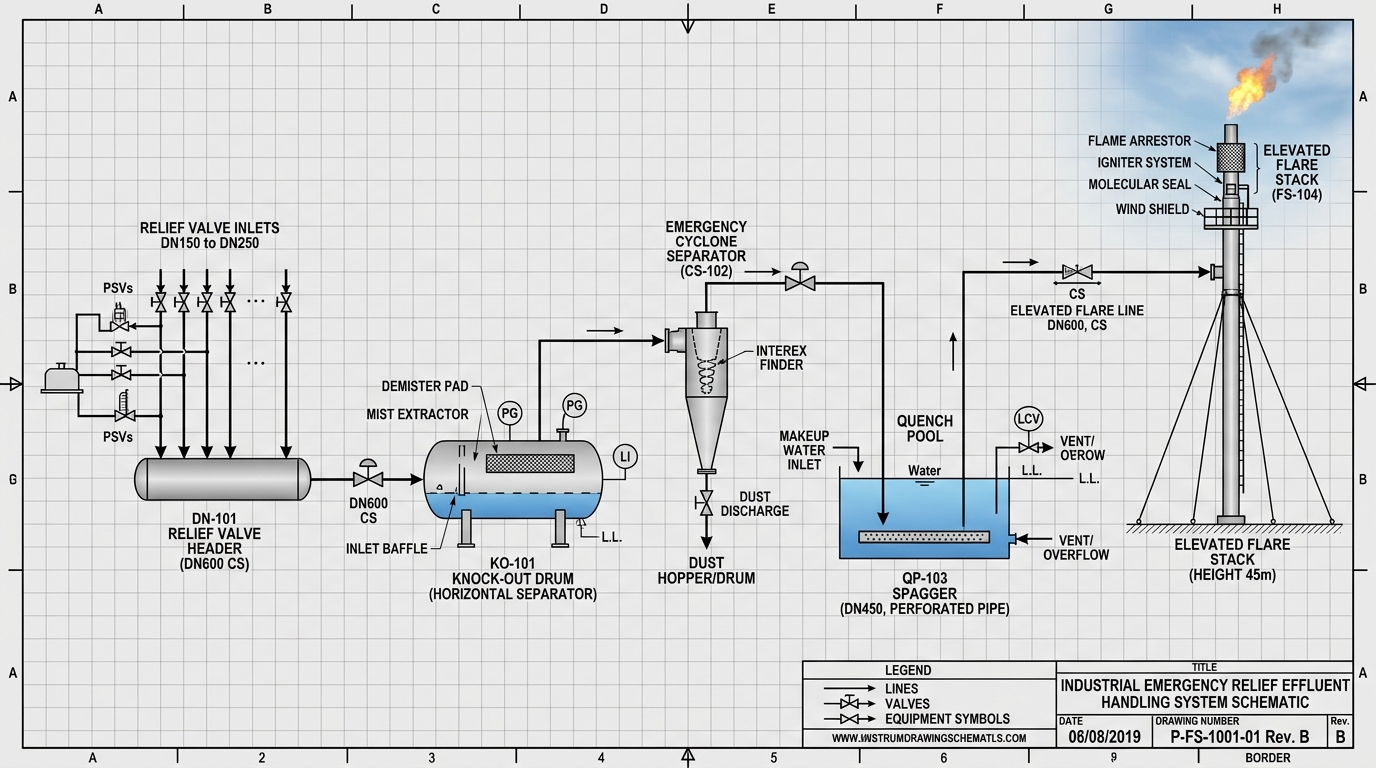
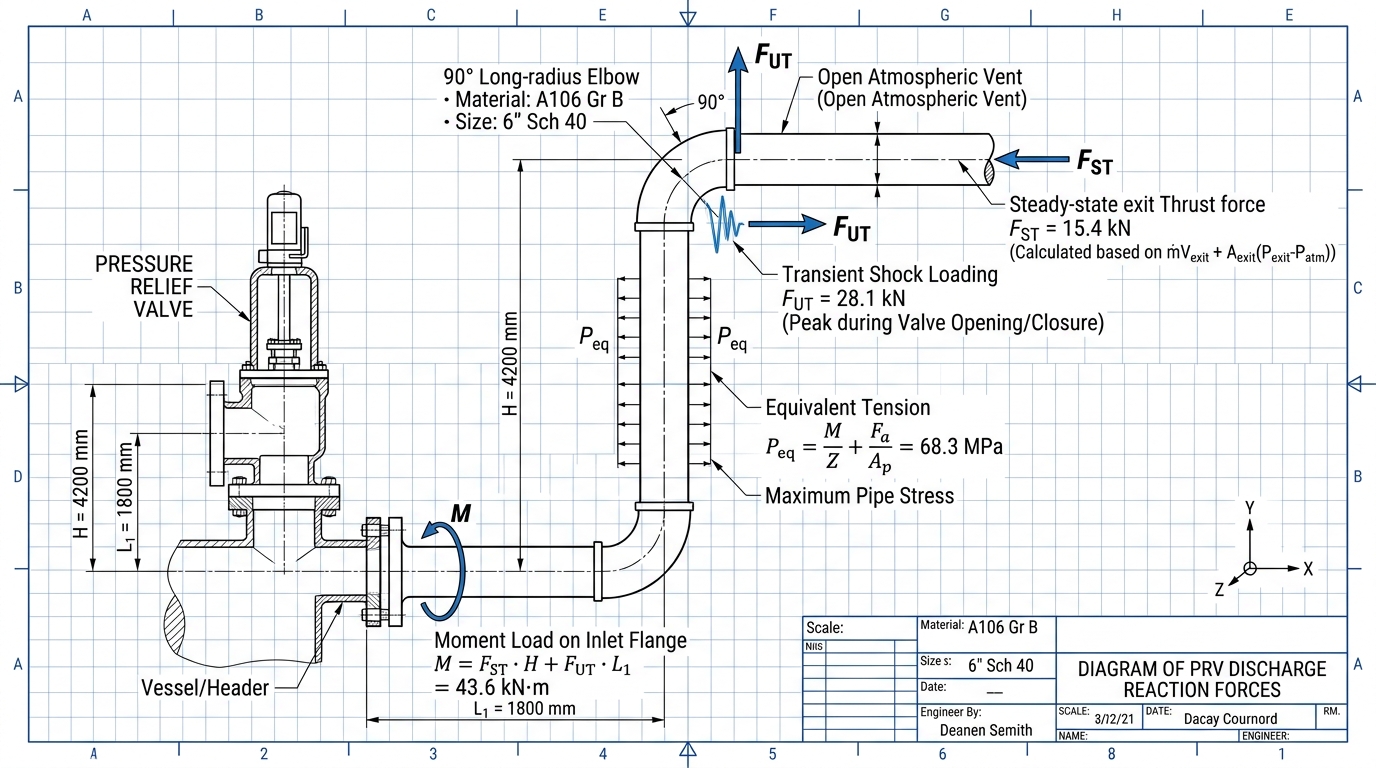
How do we determine if an exothermic hydrogenation reaction needs DIERS two-phase relief vent sizing vs SIL-2 interlocks?

Kiran S.(PharmaChemEng Hub)Sep 3

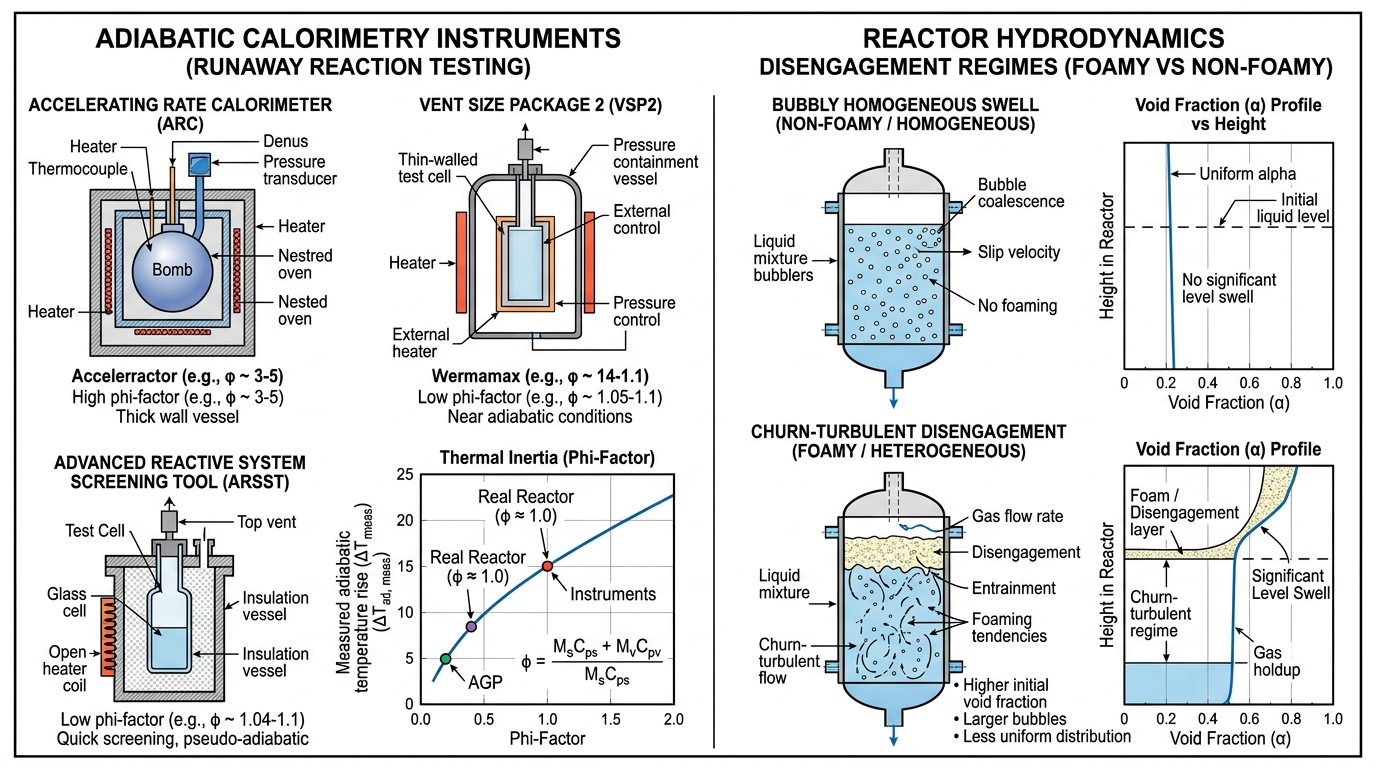
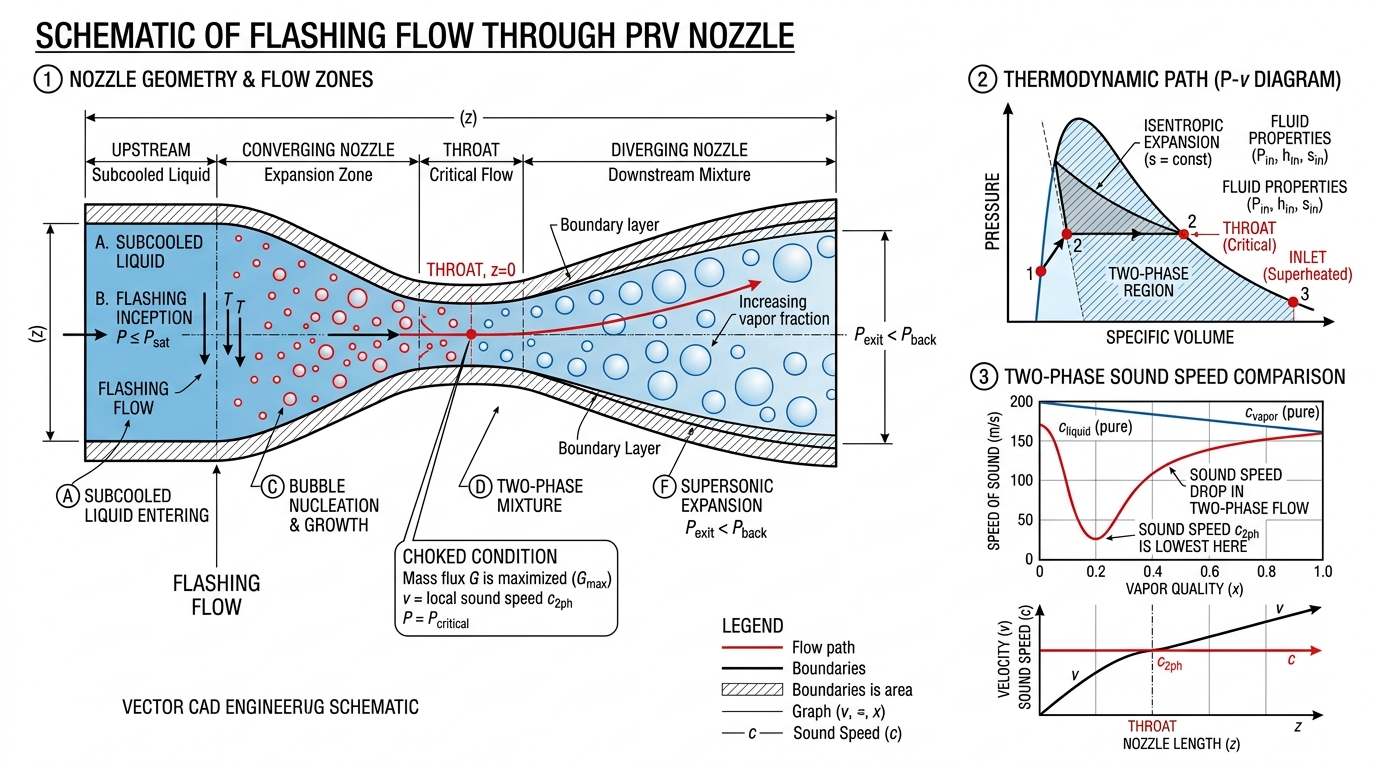
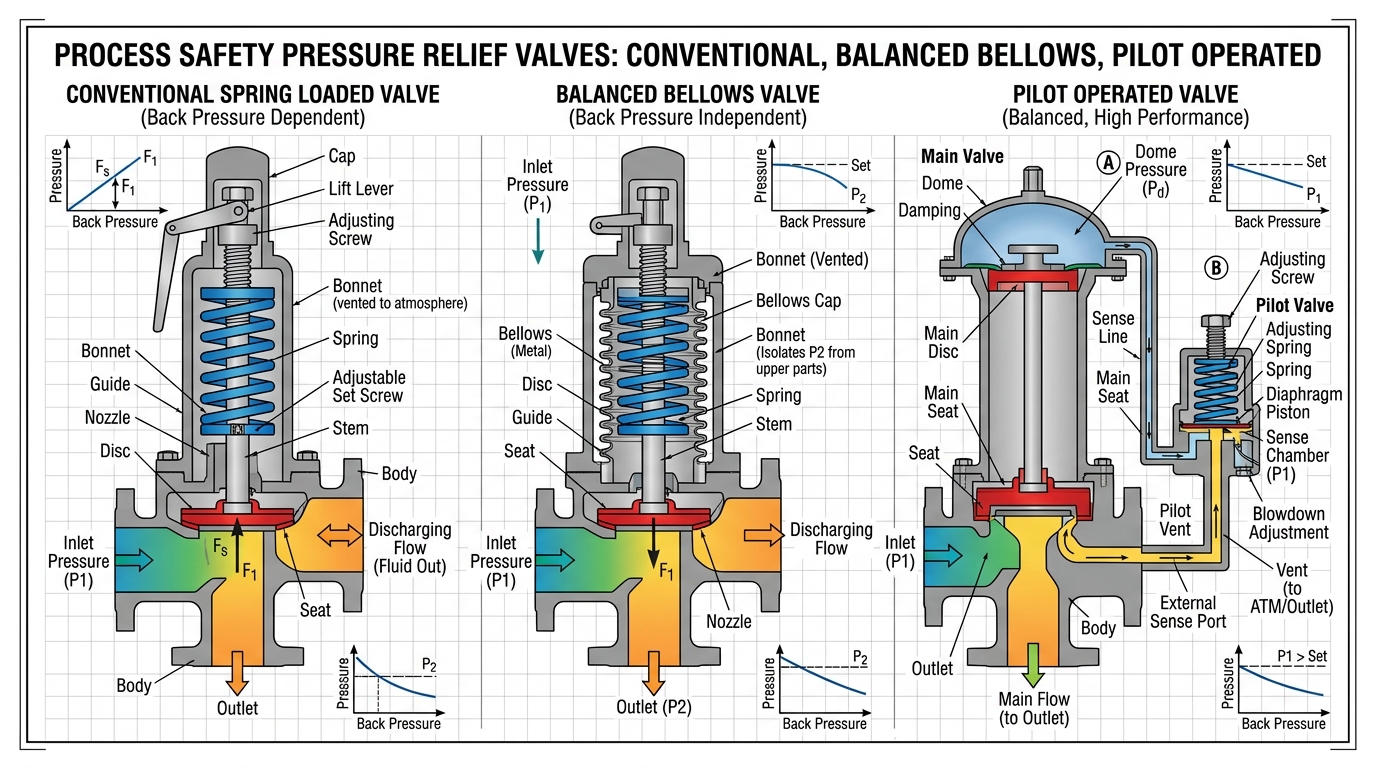
Amit, you must perform a 3-step thermal runaway screening using reaction calorimetry: 1. Reaction Calorimetry (RC1e): Measure synthesis exotherm (delta-H_rxn) and calculate adiabatic temperature rise (delta-T_ad = -delta-H_rxn / Cp). Then determine Maximum Temperature of Synthesis Reaction (MTSR = T_p + X_accum * delta-T_ad). 2. Accelerating Rate Calorimetry (ARC): Determine onset temperature of secondary decomposition (T_D) and Time-to-Maximum-Rate under adiabatic conditions (TMR_ad). 3. Stoessel Criticality Matrix: • Class 1 / 2: MTSR < T_D -> Controlled batch cooling. • Class 3 / 4 / 5: T_D < MTSR -> High thermal runaway risk if cooling fails during dosing. For relief sizing, hydrogenation systems are "hybrid" (gas generation from dissolved H2 + vapor pressure from boiling solvent). Standard single-phase API 520 equations undersize the vent by up to 500%. You must use DIERS (Design Institute for Emergency Relief Systems) Leung Omega two-phase chocked flow methodology with dual Rupture Disk + Safety Relief Valve combinations.

Vikram J.(Lupin Pharma)
Sep 1

What is the most economical condenser cooling utility for solvent recovery: Cooling Tower Water vs Chilled Water vs Brine?

Kiran S.(PharmaChemEng Hub)Sep 1

Vikram, Always match your condensing temperature to the highest-temperature utility that maintains an LMTD >= 15-20°C. Here is the operational economics comparison based on current pharmaceutical utility tariffs: • Cooling Tower Water (CTW @ ₹4.00/TR): Supply at 30°C, return at 36°C. Best for atmospheric distillation of high-to-medium boiling solvents: Methanol (64.7°C), Ethanol (78.3°C), IPA (82.6°C), Toluene (110.6°C). For a 400 kg/h methanol condensing duty (34.8 TR), CTW cost is only ₹139 / hour! • Chilled Water (CHW @ ₹9.00/TR): Supply at +5°C. Required for vacuum distillation (T_boil < 45°C) or low-boiling solvents like DCM (39.8°C) and Acetone (56°C). Cost is ₹313 / hour. • Chilled Brine (CBR @ ₹18.00/TR): Supply at -15°C. Strictly reserve for secondary vent scrubbers and cryogenic VOC traps to catch fugitive non-condensibles. Never use CBR on primary condensers for atmospheric solvents—it wastes high-cost compressor power and causes shell-side icing. Cost is ₹626 / hour.

Sneha K.(Zydus Lifesciences)
Aug 30

Why is periodic hot water sanitization (80-85°C) preferred over continuous chemical sanitization in Purified Water (PW) SS316L loops?

Kiran S.(PharmaChemEng Hub)Aug 30

Hi Sneha, Hot water sanitization (80-85°C) is universally preferred in cGMP pharmaceutical PW distribution loops for three critical reasons: 1. Zero Chemical Residues: Chemical biocides (ozone, peracetic acid, chlorine dioxide) require extensive post-sanitization rinse-out validation and continuous online TOC testing before releasing water to production. 2. Biofilm Eradication in Dead Legs: Thermal conduction penetrates into valve diaphragm crevices and dead legs (<= 1.5D rule) where chemical biocide flow velocity is stagnant. Maintaining 80°C for >= 60 minutes delivers lethal microbial kill (F_0 >= 20 min). 3. Automated Electronic Batch Records: Temperature transmitters at the loop return line provide continuous 21 CFR Part 11 compliant temperature logging on the building SCADA/DCS.

Arvind R.(Divi's Laboratories)
Aug 28

Mass Balance Closure Diagnostic: What is the acceptable tolerance limit in API manufacturing before a regulatory investigation?

Kiran S.(PharmaChemEng Hub)Aug 28

Arvind, Per ICH Q7 (Good Manufacturing Practice for Active Pharmaceutical Ingredients): 1. Total Material Balance Closure: Across a campaign, total mass reconciliation (Inputs = Output Pure API + Recovered Solvents + By-Products + Waste + Hold-up) must close between 98.0% and 102.0%. 2. Component API Yield Reconciliation: Pure active substance yield must fall within historically validated process validation limits (typically >= 95.0% of theoretical stoichiometry). If closure is < 95.0%, trigger a formal Out-Of-Trend (OOT) deviation to investigate: • Mother Liquor Assay: Uncrystallized API lost in mother liquor filtrate. • Physical Equipment Hold-Up: Material remaining on filter bags, ANFD dish bottoms, or transfer piping. • Flowmeter Density Errors: Volumetric solvent charging meters not temperature-compensated (e.g. methanol density varies 1.5% between 15°C and 35°C). • Fugitive Condenser Losses: Vent emissions from un-condensed volatile vapors.

Featured Equipment Vendors

Connect directly with manufacturers adhering to ASME-BPE, FDA, and clean utility standards.

Browse Vendor Directory
HVAC & AHU Manufacturers

Blue Star Limited - Industrial HVAC & AHU Systems

Leading manufacturer of custom double-skin AHUs, chilled water cooling coils, VFD fan assemblies, and energy-efficient pharmaceutical cleanroom air handling systems.

Mumbai / Chennai / Hyderabad, IndiaDetails
Automation Vendors

Finepac Structures Pvt. Ltd.

Designers of structured tower packing, mass transfer columns, liquid distributors, vapour-liquid separators, and distillation skids.

Pune, Maharashtra, IndiaDetails
Heat Exchanger Vendors

Jonam Engineering

Specialists in high-efficiency Shell & Tube heat exchangers, condensers, reboilers, and thermal equipment for chemical and pharma API plants.

Pune, Maharashtra, IndiaDetails
Support Engineering Excellence

Support the Platform & Buy Me a Coffee

If you find these chemical process sizing calculators, clean utility guides, and cGMP templates helpful, consider supporting our ongoing development. Your contributions help maintain high-speed servers, database modeling tools, and peer-reviewed engineering content.

SK

Seepana Kiran

Direct UPI Support
Instant UPI
paytm❤️UPI
Seepana Kiran UPI QR Code
seepana.kiran@ptyes
UPI IDseepana.kiran@ptyes
Pay via Any UPI AppScan with Paytm, Google Pay, PhonePe, or BHIM

Buy Me a Coffee

Global & Card Payments
Worldwide

Why Your Support Matters

  • 100% Free & Open technical tools for chemical and pharma engineers.
  • Fund high-performance cloud databases, serverless compute, and simulation engines.
  • Accelerate development of new Aspen-validated process modules and safety blue-prints.

Supporting international payments via Credit/Debit Cards, PayPal, and Apple Pay through our BuyMeACoffee portal.

Buy Me a Coffee on WebSecure international checkout via BuyMeACoffee